GASTRONOMY · NOVEMBER 2024
Time in a Bottle:
The Aceto Balsamico of Oria
By Oria Toscana · November 8, 2024 · 7 min read
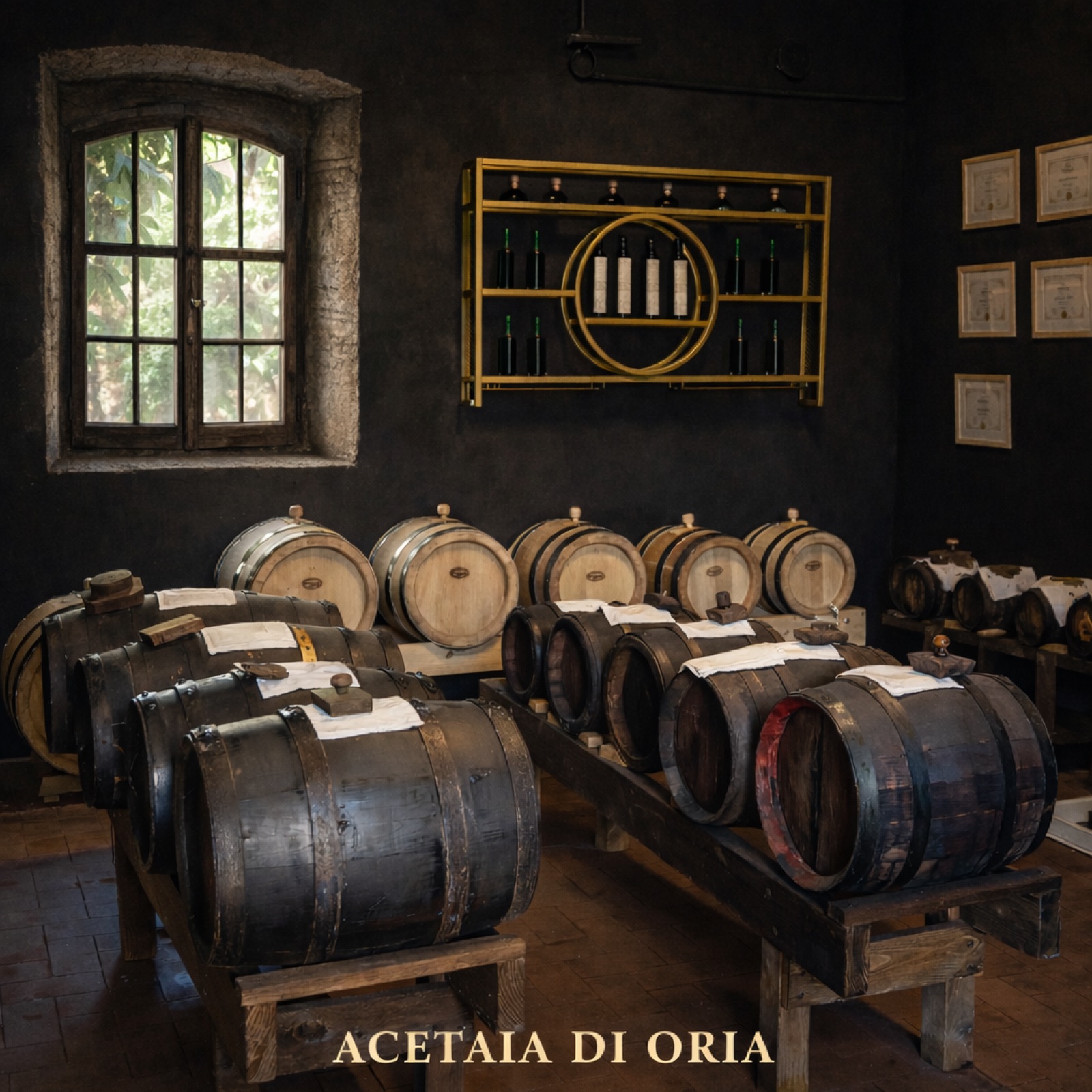
There are ingredients that are not manufactured. They are created. And to create them, the head chef is time.
In the attic of a 16th-century Tuscan house, 300 meters above sea level, the future sleeps. Rows of small barrels — made of juniper, cherry, oak, chestnut and mulberry wood — hold a liquid that, over the passing of decades, becomes something with no exact name in any language: traditional balsamic aceto.
Oria's is not the industrial aceto found in any supermarket — that is simply vinegar with added coloring. Ours is the aceto that Tuscan peasants prepared for their daughters as a wedding dowry. The one passed down from generation to generation. The one that, with a single drop, transforms a dish.
The batteria of barrels
It all begins with the grape. At Oria we use Trebbiano and Lambrusco — thick-skinned varieties, rich in sugar. The freshly pressed must is slowly cooked for hours until it reduces to a third of its volume. This cooked must — detto mosto cotto — is the base of everything.
Then begins the most surprising process in Italian gastronomy: the batteria. A series of barrels of different woods and sizes, arranged from largest to smallest. Each year, the liquid from the largest barrel is partially transferred to the next, and so on down to the smallest — the one that holds the most concentrated aceto, the fruit of decades of rackings. Our batteria was started at the end of the Second World War and has by now completed around sixty rackings: one for each year.
Each year we cook down close to a thousand litres of must and, after the long reduction and evaporation in the barrels, barely five litres of "black gold" remain. That is time turning into liquid.
An aceto only for members
From those five litres a year comes everything Oria's acetaia can offer. That is why only Oria members can acquire these products: it is not an extra or a welcome gift, it is part of the estate's philosophy. The vineyard produces wine, but it also produces aceto. Both are children of the same land.
The aceto that reaches our members has aged for decades in the batteria, passing from barrel to barrel down to the smallest one. The difference between a young aceto and one like this, though it sounds small when you say it, is vast when you taste it.
"A drop of true aceto balsamico on a wild strawberry does not decorate the plate. It transforms it. It is chemistry and time in their purest state." — Roberto Cipresso
How to use it (and how not to)
Traditional aceto balsamico does not go on salads. That is for the industrial kind. The traditional one is used in the tiniest amounts — a drop, two — over grilled meats, aged parmesan, vanilla ice cream, ripe strawberries, or simply on the back of the hand to taste it.
Heat destroys it. An excessive amount nullifies it. It is an ingredient that demands respect and minimal intervention — exactly like Roberto's philosophy in viticulture.
The aceto of Oria, reserved for our members
See the membership plans